
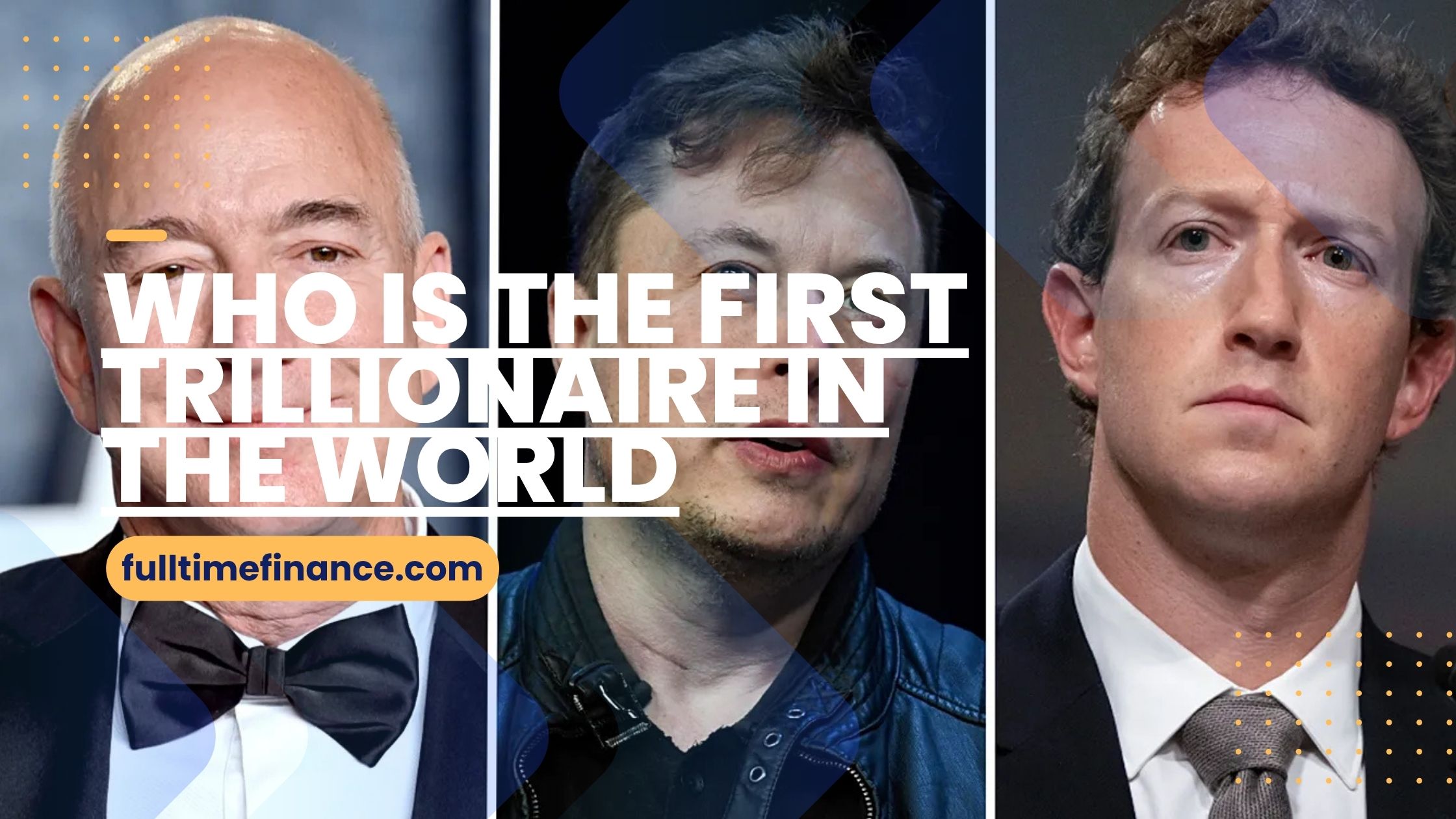
If you’re searching for who is the first trillionaire in the world, the most accurate answer in 2026 is also the most surprising one: there isn’t one. Not officially. Not yet.
A trillion dollars — $1,000,000,000,000, with twelve zeros — is a number so large it has never appeared next to a single human name on the Forbes Real-Time Billionaires list or the Bloomberg Billionaires Index. It is roughly the entire annual GDP of the Netherlands. It is more than the combined market cap of McDonald’s, Coca-Cola, Nike, and Disney. It is, until very recently, a figure economists used to describe national debts, not personal bank accounts.
But the gap between “richest person alive” and “first trillionaire” has narrowed faster in the last 24 months than at any point in recorded financial history. The question is no longer if someone crosses the line — it is who, and when.
This guide answers both, using the latest 2026 valuations from Forbes, Bloomberg, and the Kalshi prediction markets, plus the projections that financial analysts are actually paying attention to right now.
Quick Facts: The Trillionaire Race at a Glance
| Person | 2026 Net Worth (Forbes) | Primary Wealth Source | Odds of Being First Trillionaire |
|---|---|---|---|
| Elon Musk | ~$811 billion | Tesla, SpaceX, xAI, X | 75–78% (Kalshi, Feb 2026) |
| Jensen Huang | ~$170 billion | Nvidia | Long shot — but accelerating |
| Larry Ellison | ~$240 billion | Oracle | Outside contender via cloud/AI |
| Mark Zuckerberg | ~$230 billion | Meta | Long-term play |
| Jeff Bezos | ~$240 billion | Amazon, Blue Origin | Stalled vs. Musk |
| Bernard Arnault | ~$190 billion | LVMH | Slowest trajectory |
| Warren Buffett | ~$155 billion | Berkshire Hathaway | Not pursuing it |
Net worth figures fluctuate daily and reflect Forbes Real-Time and Bloomberg index data as of Q2 2026.
Why “First Trillionaire” Is Suddenly a Real Question
For most of human history, no individual on Earth had a net worth that broke $100 billion. John D. Rockefeller’s fortune at his peak — adjusted for inflation — is often estimated at roughly $400 billion in today’s dollars, which still leaves a $600 billion gap to the trillion mark.
Then four things happened, almost at once:
- The AI boom. Nvidia’s market cap rocketed past $3 trillion. Companies tied to artificial intelligence — chips, models, infrastructure — saw equity holders gain hundreds of billions in 18 months.
- The SpaceX revaluation. Private secondary-market trades pushed SpaceX past a $400 billion valuation, then past $700 billion, then past $1 trillion — making it the most valuable private company ever.
- Concentrated founder ownership. Today’s tech billionaires hold dramatically larger personal stakes than the industrialists of a century ago. Elon Musk owns roughly 42% of SpaceX. That single number is more important to the trillionaire question than almost any other.
- Index calculations got faster. Forbes and Bloomberg now revalue private companies in near real time, meaning a $200 billion swing in SpaceX’s implied valuation translates to an instant $80+ billion change in Musk’s listed wealth.
The result: in February 2026, Elon Musk crossed the $800 billion mark — the first individual to ever do so. In the same month, the Kalshi prediction market gave him a roughly 75% probability of crossing $1 trillion before the end of 2026, and a 91% probability before 2029.
That is not a guarantee. But on the question of “who is the first trillionaire in the world,” there is now a clear favorite for the first time in history.
#1 Frontrunner: Elon Musk
If you had to bet today, you bet on Musk.
His path to $1 trillion is built on three legs, and at least two of them are growing faster than analysts modeled even a year ago.
Tesla (TSLA). Musk holds roughly 12–13% of Tesla, a stake worth somewhere between $150 and $200 billion depending on the trading day. Tesla’s stock has been volatile — down significantly from its late-2024 peak — and Q1 2026 profits dropped sharply. Tesla is no longer the primary engine of his wealth.
SpaceX + xAI (merged February 2026). This is the big one. The combined SpaceX-xAI entity was valued at approximately $1.25 trillion at the time of the merger, and Musk owns about 42–43% of it. That single stake is worth somewhere in the range of $525 billion — more than the entire net worth of any other living person except Musk himself.
X (formerly Twitter) and Neuralink. Smaller contributors, but Musk’s 79% ownership of X and his Neuralink stake add tens of billions more.
The accelerant nobody is ignoring: the rumored SpaceX IPO. Reports suggest a public offering could price the company at $1.5–$1.75 trillion, with a target window in mid-to-late 2026. If that IPO prices anywhere near those numbers, Musk’s stake alone would be worth $630–$750 billion. Add Tesla, X, and Neuralink, and his net worth crosses $1 trillion the day the bell rings.
This is what 24/7 Wall St. analysts mean when they call a specific date — some have circled June 12, 2026 — as the most plausible trigger event. It may not happen on that exact day. But the mechanism is clear, and it does not require Tesla to recover or AI to keep its current pace. It just requires SpaceX to list at the price secondary markets are already implying.
Reality check: Musk’s wealth is paper wealth. His stakes are concentrated, illiquid, and exquisitely sensitive to two specific risks — a Tesla collapse and a delayed or downpriced SpaceX IPO. A 30% haircut on either could push the trillion-dollar moment from 2026 into 2028. The probability is high. The timing is not.
#2 Dark Horse: Jensen Huang
Nvidia’s CEO has gone from “successful chipmaker” to “central figure of the AI economy” in roughly 36 months. His net worth has roughly 8x’d since 2022.
Huang owns about 3.5% of Nvidia — a smaller percentage than Musk owns of his companies, but Nvidia’s market cap has touched $3 trillion, making even a small slice enormous. As of 2026, his net worth sits in the $170+ billion range, well behind Musk but growing on a steeper curve than anyone else in the top 10.
Two things would have to happen for Huang to leapfrog Musk to the trillionaire milestone:
- Nvidia’s market cap would need to double again — a stretch, but not impossible if the AI infrastructure buildout continues at its current pace.
- Musk’s SpaceX IPO would have to be delayed or repriced sharply downward.
Huang is the candidate to watch if the SpaceX timeline slips. He is not the favorite — but he is the only candidate whose wealth is increasing at a rate that mathematically rivals Musk’s.
#3 The Stalled Class: Bezos, Arnault, Zuckerberg, Ellison
These four are extraordinarily rich. None of them are realistic candidates to be the first trillionaire.
Jeff Bezos was, for years, the projected first trillionaire. A widely circulated 2020 Comparisun study famously predicted he’d reach $1 trillion by 2026. He hasn’t — and won’t. His Amazon stake has been diluted by share sales (much of it funding Blue Origin), his 2019 divorce settlement transferred ~$38 billion to MacKenzie Scott, and Amazon’s stock growth has been steady rather than explosive. He sits around $240 billion in 2026. Doubling that takes years.
Bernard Arnault is the only non-tech name in the top tier. LVMH’s luxury empire is enormously profitable, but luxury goods don’t compound the way AI chips or rocket equity does. Most projections place Arnault’s trillion-dollar milestone in the 2033–2035 range, if it happens at all.
Mark Zuckerberg holds a controlling stake in Meta and has benefited massively from the AI re-rating of big tech. But his net worth — around $230 billion in 2026 — needs roughly 4–5x growth, and Meta’s market cap doesn’t yet have the runway SpaceX appears to have. Projections place him as the youngest potential trillionaire, possibly by his early 50s — i.e., closer to 2036 than 2026.
Larry Ellison has gained more from the AI boom than any of the four, with Oracle’s cloud business surging. His net worth has nearly doubled since 2023. But he started lower, and even at his current pace, the trillion mark is several years off.
What About Warren Buffett?
A satirical April Fools’ article from MoneyLion famously claimed Warren Buffett had quietly become the world’s first trillionaire by “doing nothing but waiting.” It went viral because the joke landed: Buffett’s net worth of roughly $155 billion in 2026 places him far from the trillionaire threshold, and he has spent decades giving his money away through the Giving Pledge.
The truth is more interesting than the joke. Buffett could have been closer to a trillion if he had never donated a dollar — Berkshire Hathaway’s compounding since 1965 is arguably the most impressive long-term wealth creation engine in history. But he has given away tens of billions, and Berkshire’s structure doesn’t concentrate his ownership the way Tesla concentrates Musk’s. Buffett is not in the trillionaire race because he chose not to be.
When Will the First Trillionaire Actually Happen?
Three credible scenarios, based on current data:
Scenario A — 2026 (most likely): SpaceX IPOs in mid-to-late 2026 at $1.5T+. Musk’s combined holdings cross $1 trillion on the day of listing. Probability: ~60% based on Kalshi-implied odds and analyst consensus.
Scenario B — 2027–2028: SpaceX IPO is delayed, repriced, or scaled down. Musk gets there anyway via continued private-market revaluation plus Tesla recovery, plus xAI growth. Probability: ~25%.
Scenario C — Late 2020s, different person: Musk’s wealth contracts via a Tesla collapse or regulatory disruption, and Jensen Huang or another AI-economy figure becomes the surprise first trillionaire. Probability: ~10–15%.
What virtually no serious analyst projects: a non-tech, non-American trillionaire arriving first. The geography and the industry are clear. The name is the question.
How Much Is $1 Trillion, Really?
Numbers this large stop meaning anything to the human brain. A few comparisons that help:
- Time. One million seconds is about 12 days. One billion seconds is about 32 years. One trillion seconds is roughly 31,700 years — longer than human civilization has existed.
- Spending. If you spent $1,000,000 every single day, it would take you about 2,740 years to spend $1 trillion.
- Stacking. One trillion $100 bills, stacked flat, would form a tower roughly 679 miles tall — more than twice the orbital altitude of the International Space Station.
- National economies. $1 trillion is larger than the entire 2025 GDP of Switzerland, Saudi Arabia, Argentina, or Sweden.
This is the scale we are now using to describe the wealth of a single living person.
Will More Than One Trillionaire Emerge?
Yes — and probably soon after the first.
Oxfam’s January 2025 Davos report projected that at least five trillionaires would emerge within a decade, a number widely treated as conservative inside finance. The same forces creating the first trillionaire — concentrated equity ownership, transformative technology platforms, and faster private-market revaluations — will create the next ones.
If Musk crosses the line in 2026, expect Huang, Zuckerberg, Bezos, and possibly Ellison to follow before 2032. The “trillionaire” status, like “billionaire” before it, will quickly stop being singular and become a category.
Frequently Asked Questions
Who is the first trillionaire in the world right now?
No one, as of 2026. The closest individual is Elon Musk at roughly $811 billion (Forbes) or $636 billion (Bloomberg’s more conservative private-company valuations). Prediction markets give him a 75%+ chance of crossing $1 trillion before 2027.
Will Elon Musk be the first trillionaire?
Most analysts and prediction markets say yes — likely upon the SpaceX IPO, expected mid-to-late 2026. His path runs primarily through his ~42% stake in the SpaceX-xAI combined entity, not Tesla.
Was Warren Buffett ever the first trillionaire?
No. A viral April Fools’ article in 2026 jokingly claimed this. Buffett’s actual net worth is roughly $155 billion, and he has donated tens of billions through the Giving Pledge.
Has any historical figure ever been worth $1 trillion in today’s dollars?
Disputed. Some estimates place John D. Rockefeller’s peak inflation-adjusted wealth at $400 billion in modern dollars — well short of $1 trillion. Mansa Musa, the 14th-century Mali ruler, is sometimes described as the wealthiest person ever, but the figures are speculative and not measured by modern standards.
When will the first trillionaire emerge?
The most probable window is mid-to-late 2026, contingent on a SpaceX IPO. The fallback range is 2027–2028. Beyond 2030 is considered unlikely by current prediction markets.
How many trillionaires will exist by 2035?
Oxfam projects at least five within a decade of the first. Some analysts argue the number could be higher if AI-driven equity gains continue at their current pace.
The Bottom Line
The question “who is the first trillionaire in the world” has, for the first time in history, a clear favorite and a clear timeline. The favorite is Elon Musk. The timeline is the next 6–24 months. The trigger event is almost certainly the SpaceX IPO.
What makes this moment unusual is not just the size of the number. It is that the gap between extraordinary wealth and the next round number — once a generational distance — has been compressed into a single news cycle. A trillion-dollar individual is no longer a hypothetical. It is a calendar event.
Whether that is a triumph of innovation, a symptom of structural inequality, or both at once, depends on who you ask. But the math is no longer in doubt.